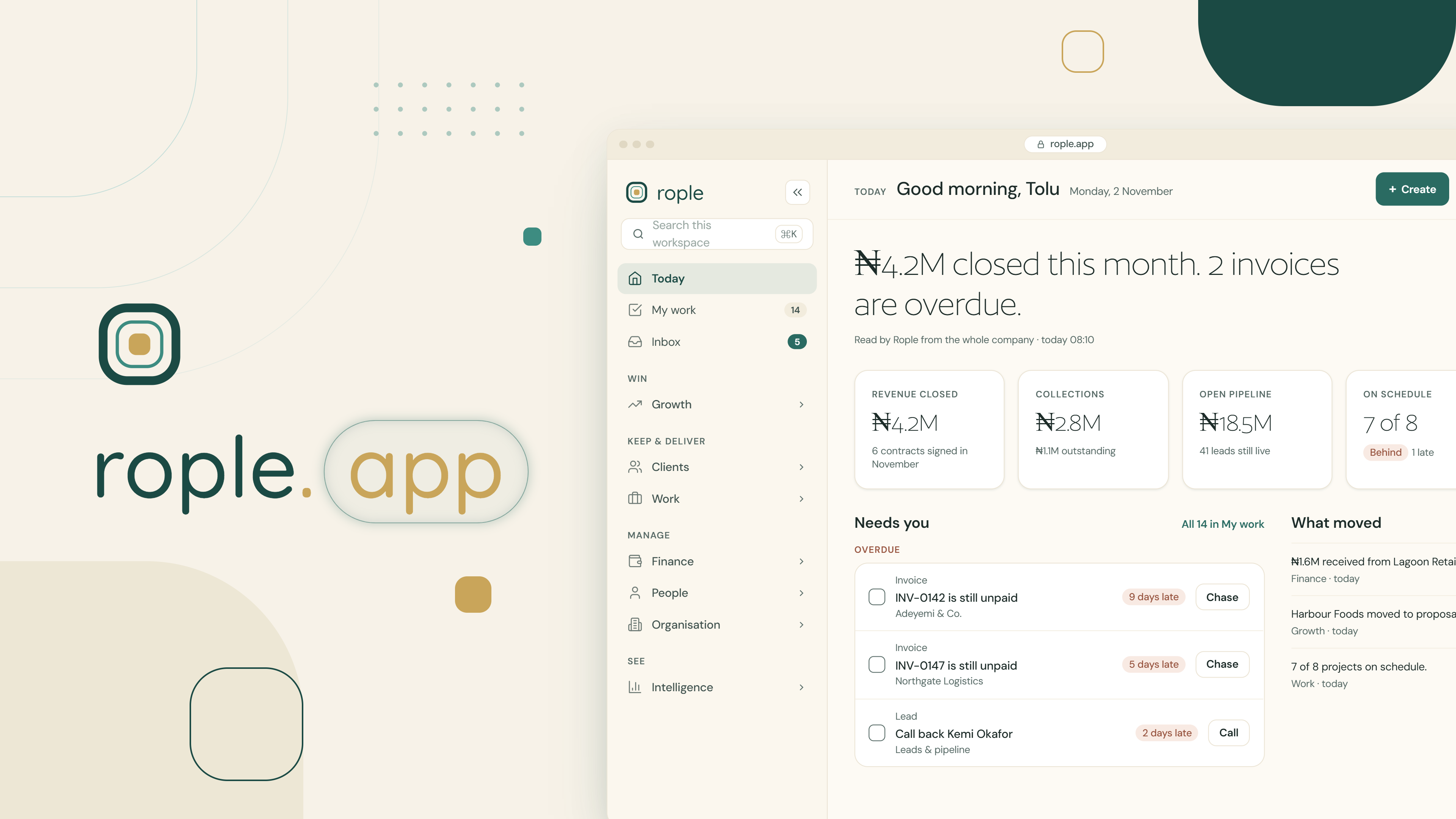
What is Rople? Rople is a business workspace built to solve your business problems, not just track the work. It holds how you and your team run things (your customers, the work, the money, your goals and who owns each of them) on one set of records. Because it holds all of that, it can see where you're stuck. Every night it checks what's late, unpaid or stuck and tells whoever owns it. If nobody acts, their manager hears about it.
Key takeaways
- Rople is a workspace for your goals, your people and your work. It is not a task manager, a CRM and a finance tool bolted together.
- One record runs start to finish: a lead becomes a client, the work is delivered through a project, a delivered milestone makes its payment ready to invoice, and the money can move a goal.
- Progress is worked out from the work, not typed in. Nobody sets a percentage by hand.
- Every night about twenty checks run across the business. Each alert names an owner and a reason, and goes to their manager after three days if nobody acts.
- It is free for up to 5 people. Starter and Pro have 14 days free with no card.
The problem Rople exists to solve
Picture a Monday in a business of twelve people. A client calls to ask why the second phase hasn't started. The project lead says it's waiting on sign-off; the account manager thought sign-off came weeks ago. Finance never invoiced the first phase, because nobody told them it was done. The owner, who meant to follow it all up on Friday, hears it from the client.
Nobody here was lazy. The business lived in people's heads and in tools that don't know about each other. The sales tool knew the client, the task board knew the work, the spreadsheet knew the money. Nothing knew all three, so nothing noticed that delivered work had sat uninvoiced for three weeks.
That is the gap Rople is built for. Most business management software records activity: a card moved, a task ticked. Rople is designed to hold the outcome the activity was for, and to notice when it isn't happening.
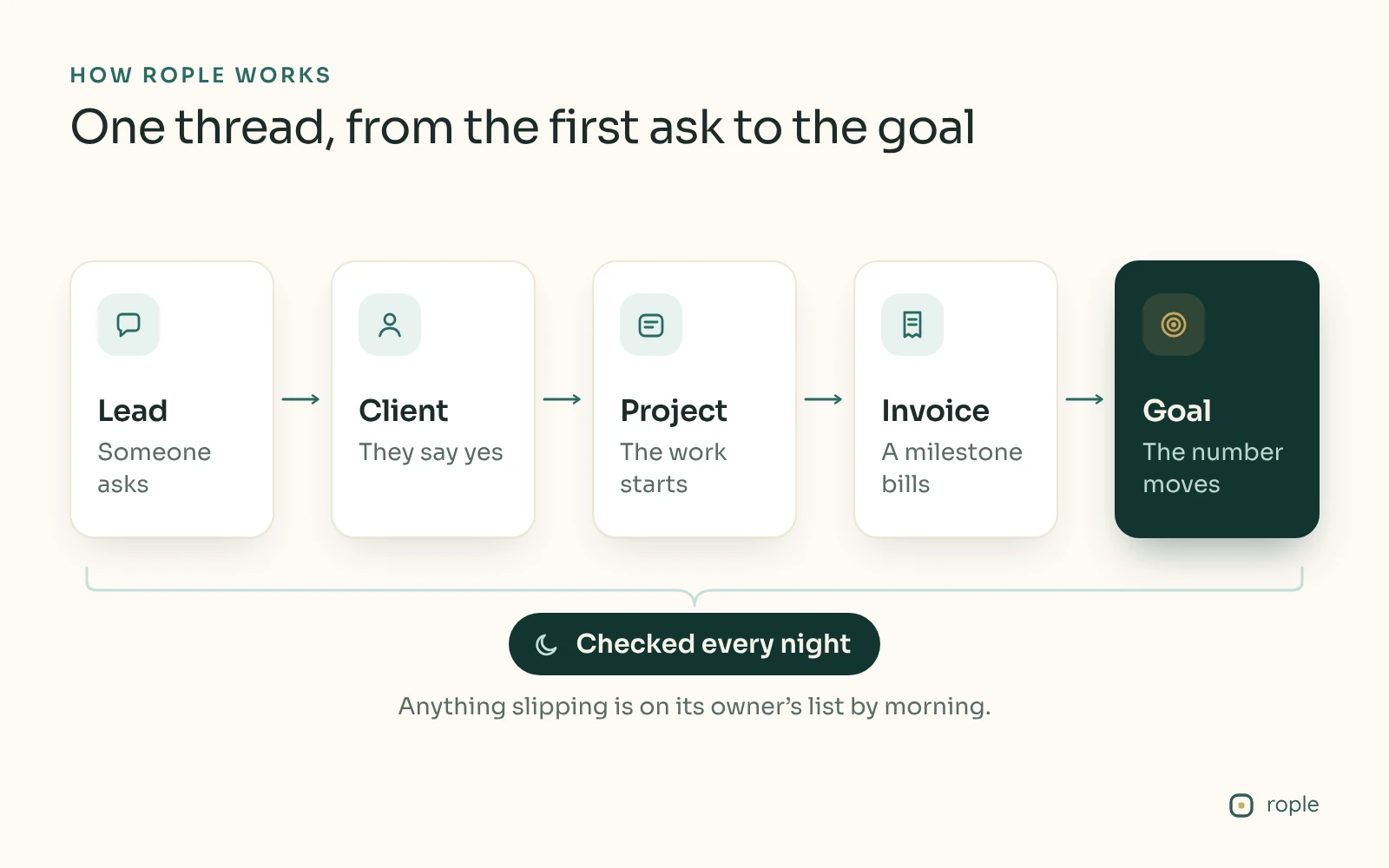
One record, start to finish: the thread Rople follows from the first enquiry to the goal it moves.
One record, start to finish
A business is one chain of events, so Rople keeps it as one set of records. Here is how a piece of business moves through it.
- A lead arrives in Leads and pipeline, from your website form, an import or by hand. If nobody has spoken to it for six days, it counts as gone quiet, and a follow-up appears in the holder's My work without anybody setting a reminder.
- The sale closes. Accept a proposal, or open an engagement from the lead. Rople finds the client's account by email or phone, or opens one, and the engagement gets its contract value, its billing schedule and an onboarding checklist. The engagement keeps the lead it came from, so you can see which source the revenue came from.
- The work is delivered. A client delivery project names the engagement it delivers. Its milestones carry tasks, owners and dates, and a milestone can ask for evidence before it can be marked complete.
- The money is ready. A payment on the billing schedule can wait on a milestone. When the milestone is complete, that payment becomes ready to invoice, and the engagement's officer gets an Invoice row in My work. Nobody has to remember to tell finance (billing guide).
- The goal moves. A target on a client account is a key result under a goal. When the target counts money collected, the payment that arrives moves it, and the key result moves the goal's progress ring.
Two honest notes. The full chain, with engagements, invoicing and collections, is on the Pro plan. And the payment moves a goal only when somebody has set a target that counts money collected; Rople does not guess which goal a payment belongs to.
Tracking outcomes, not just activity
In most tools a goal is a box where somebody types "60%". In Rople, an objective's progress is computed from the key results under it. Ticking a task under a key result moves the key result, and that moves the objective. If an objective reads zero, nothing under it has moved, and the fix is to do the work, not to edit the number. The goals guide shows how.
The same rule runs through the figures. Every figure on Home and on each module is worked out from your records the moment you open it. Revenue closed is the contract value of engagements opened in the cycle, never the estimate somebody typed on a lead. Where there is nothing behind a number, Rople leaves it out instead of printing a zero that reads like bad news.
You can read more about goals that move from the work in team goal tracking software.
The nightly check: accountability that doesn't depend on memory
In most businesses, follow-up depends on a manager remembering to ask. When the manager is busy, nothing gets asked, and problems surface once they are already expensive.
Rople runs about twenty checks across the business every night. Among them:
- work past its date, and milestones running late;
- a budget used up, or margin running thin;
- money overdue, and a broken promise to pay;
- a breached service clock, a client at risk, a lead gone quiet;
- somebody booked over their capacity.
Each alert is raised once per risk, names the person who owns the record and says why it was raised. It appears at the top of their My work under Alerts for you. They can acknowledge it or resolve it, and if they resolve it while the risk is still there, the next run raises it again. If nobody acknowledges it within three days, it goes to the owner's manager. Three days is the default; a workspace admin can change it, and switch each check on or off with its own threshold. The alerts guide lists every check.
Collections has its own trail on Pro: an overdue payment goes to the owner's manager from 7 days late and is flagged to finance from 30, and a broken promise to pay comes back to My work on its own.
The result is an escalation trail nobody has to keep up: the owner hears first, and the manager hears only when it's needed.