This first 90 days new manager checklist splits your start into three blocks. In days 1–30 you listen and learn: meet every person one-to-one, learn how the work and the money actually flow, and change very little. In days 31–60 you set direction: agree two or three team goals, start a steady one-to-one rhythm and fix one thing that's slowing everyone down. In days 61–90 you deliver and review: show a result, give honest feedback both ways and plan the next quarter. Each block below has a tick-box list you can copy.
Key takeaways
- A 30-60-90 day plan for new managers is listen, then set direction, then deliver. Doing them in the wrong order is the most common way new managers lose a team's trust.
- Your first month is for questions, not changes. Meet every person one-to-one before you decide anything about them.
- By day 60 the team should know its two or three goals, who owns each, and how progress will be measured.
- By day 90 you should have one visible result, a working one-to-one rhythm and a plan for next quarter.
- Write things down as you go. What you learn in week two is the context you'll need in month three.
Why the first 90 days matter so much
When you take over a team, people form their view of you quickly, and most of it comes from small things: whether you turned up to the one-to-one you booked, whether you did what you said you'd do, whether you asked before you changed something. Gallup's research found that managers account for at least 70% of the variance in employee engagement across business units (Gallup). Put simply, the team's experience of work depends a great deal on you.
The 90-day frame is useful because it's long enough to understand the work and short enough to keep you honest. It also gives your own manager a clear way to see how you're getting on. Share your plan with them in week one.
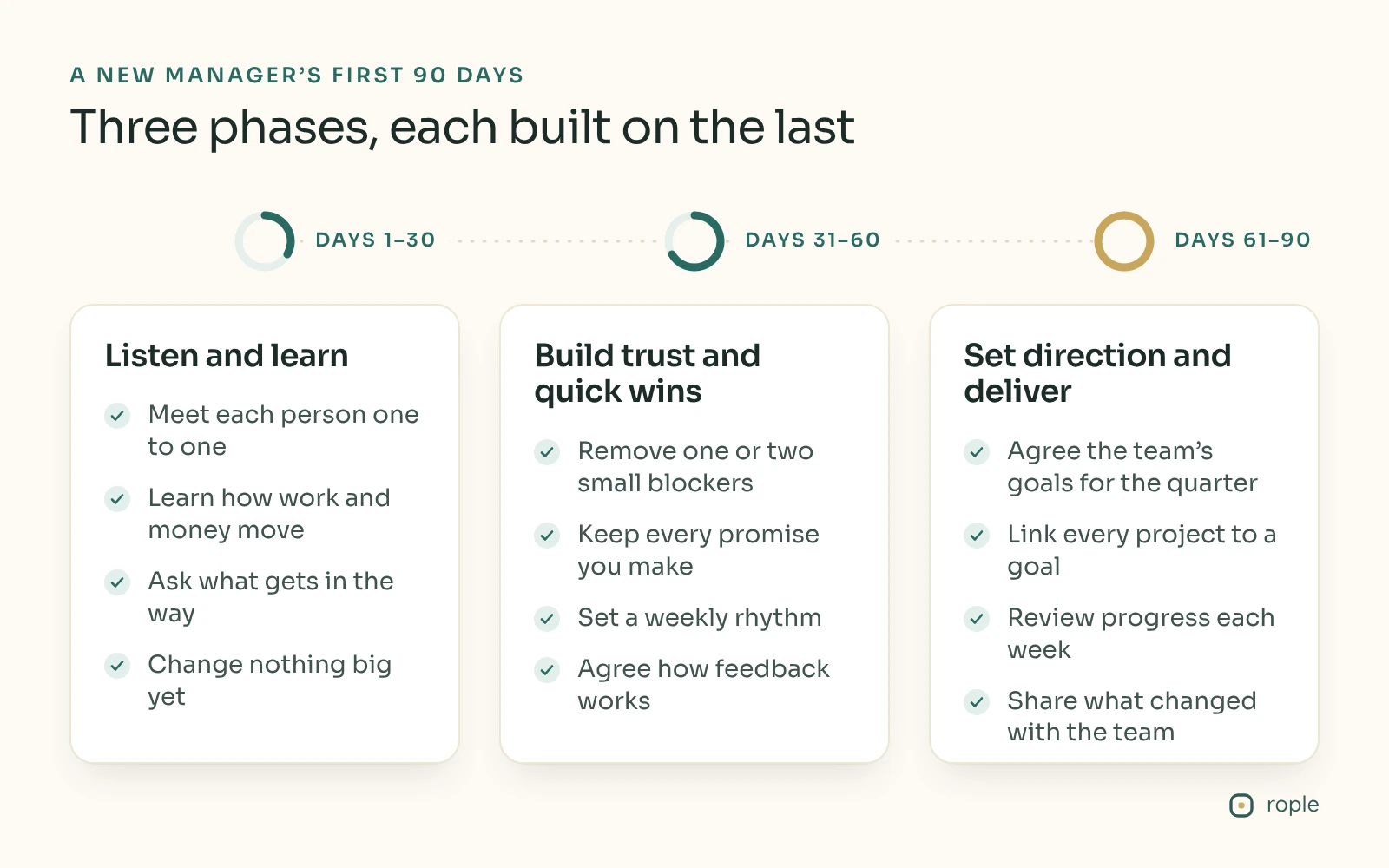
The first 90 days in three phases. Each one builds on the last.
The first 90 days new manager checklist at a glance
| Phase | Your focus | What you should have by the end | You're on track if |
|---|---|---|---|
| Days 1–30 | Listen and learn | A one-to-one with every person, a map of who owns what, the team's numbers in your head | You can explain how the team's work turns into results, in your own words |
| Days 31–60 | Set direction | Two or three agreed team goals, a weekly or fortnightly one-to-one rhythm, one process fixed | Each person can name the team goals and what they own |
| Days 61–90 | Deliver and review | One visible result, a first goal review, feedback given and asked for, a plan for next quarter | Your manager and your team would describe the same priorities |
Days 1–30: listen and learn
Your job this month is to understand the team, the work and the expectations on you, before you try to improve any of it. The temptation is to prove yourself with quick changes. Resist it. A change made in week two, before you know why things are the way they are, usually undoes something that was there for a reason.
Week 1 checklist
- Meet your own manager and agree what success looks like at 30, 60 and 90 days
- Ask your manager what they expect you to fix, and what they'd hate you to break
- Book a 30–45 minute one-to-one with every person on your team in the first two weeks
- Read the last quarter's goals, reviews and any project or client reports you can find
- Learn the tools: where tasks live, where clients and money are recorded, how people communicate
- Introduce yourself to the team: how you like to work, what you're here to do, what you don't know yet
Weeks 2–4 checklist
- Hold your first one-to-one with each person, and ask everyone the same five questions (below)
- Map the work: what the team delivers, who owns each piece, and where it waits on someone else
- Learn the numbers the team is judged on, and where they come from
- Meet the people your team depends on, and the people who depend on your team
- Sit in on the work: a client call, a delivery review, a sales meeting
- Write down the three problems you hear most often, and who raised them
- Agree one small, safe improvement the team asked for, and do it
The five questions to ask in every first one-to-one
Ask everyone the same questions, so you can compare the answers.
- What are you working on right now, and what are you proudest of from the last few months?
- What gets in the way of your work most often?
- What should I keep doing that the last manager did well, and what should I change?
- How do you like to receive feedback: in the moment, in writing, in our one-to-ones?
- What would you like to be doing a year from now?
Take notes and keep them. When someone tells you in week two that client handovers are a mess, and you fix handovers in week eight, say where the idea came from. Nothing builds trust faster. If you'd like more on this, our guide to how to build rapport with a new team quickly goes deeper.
Days 31–60: set direction
By now you know the people and the work. This month you turn what you've heard into a small number of clear goals, set up the rhythm you'll manage by, and fix one thing that's slowing everyone down.
Goals checklist
- Draft two or three team goals for the rest of the quarter, linked to what your manager needs
- Give each goal two or three measurable key results, each with a starting point and a target
- Agree the goals with the team, not just announce them. Ask what's missing and what's unrealistic
- Name one owner for every key result
- Put the tasks that will move each key result underneath it, with owners and dates
- Decide how progress will be measured, and make sure it comes from the work, not from someone's estimate
A useful rule of thumb: if a goal can't be measured without someone typing a percentage, rewrite it until it can. "Improve client onboarding" becomes "every new client has a kickoff meeting within five working days". If you're choosing a tool for this, our guide to team goal tracking software covers what to look for.
Rhythm checklist
- Set a recurring one-to-one with each person: weekly for most new teams, fortnightly for experienced people
- Keep one-to-ones for the person, not for status updates. Status belongs in the work itself
- Start a short weekly team meeting with an agenda, decisions and actions with owners
- Carry open actions from one meeting into the next, so nothing quietly disappears
- Give your first piece of specific, positive feedback to each person, about a real piece of work
Workload and process checklist
- Check who is overloaded and who has room, using hours and deadlines, not impressions
- Pick the one process the team complains about most and fix it with them
- Agree what "done" means for the team's most common piece of work
- Make sure every piece of open work has an owner and a date