If you're wondering how to build rapport with a new team quickly, the short answer is: meet each person one-to-one in your first two weeks, ask about their work before you talk about yours, keep every small promise you make, and give specific credit for real work within days of it happening. Rapport isn't built at a team social. It's built in the dozens of small moments where people find out whether you listen, whether you follow through and whether it's safe to tell you bad news.
Key takeaways
- Rapport is trust built in small, repeated moments. Consistency beats charisma.
- Meet every person one-to-one in the first two weeks, and spend most of the time listening.
- Keep a written list of what you promised, and close every item. A kept small promise is worth more than a big speech.
- Give credit that names the work, the behaviour and the effect, and give it the same week.
- How you react to the first piece of bad news sets the tone for every piece after it.
Why rapport matters more than a good first impression
A new manager is, for a while, a stranger who controls a large part of everyone's working day. Until people know how you'll behave, they hold back: they won't tell you about the problem, they won't push back on a bad idea, and they'll wait to see.
When Google studied what made its teams effective, the first of the five dynamics it found was psychological safety: whether people feel they can take a risk in front of each other without feeling insecure or embarrassed (Google re:Work). Rapport is where that starts. It isn't the goal in itself. It's the condition that lets people tell you the truth early, while the truth is still cheap to act on.
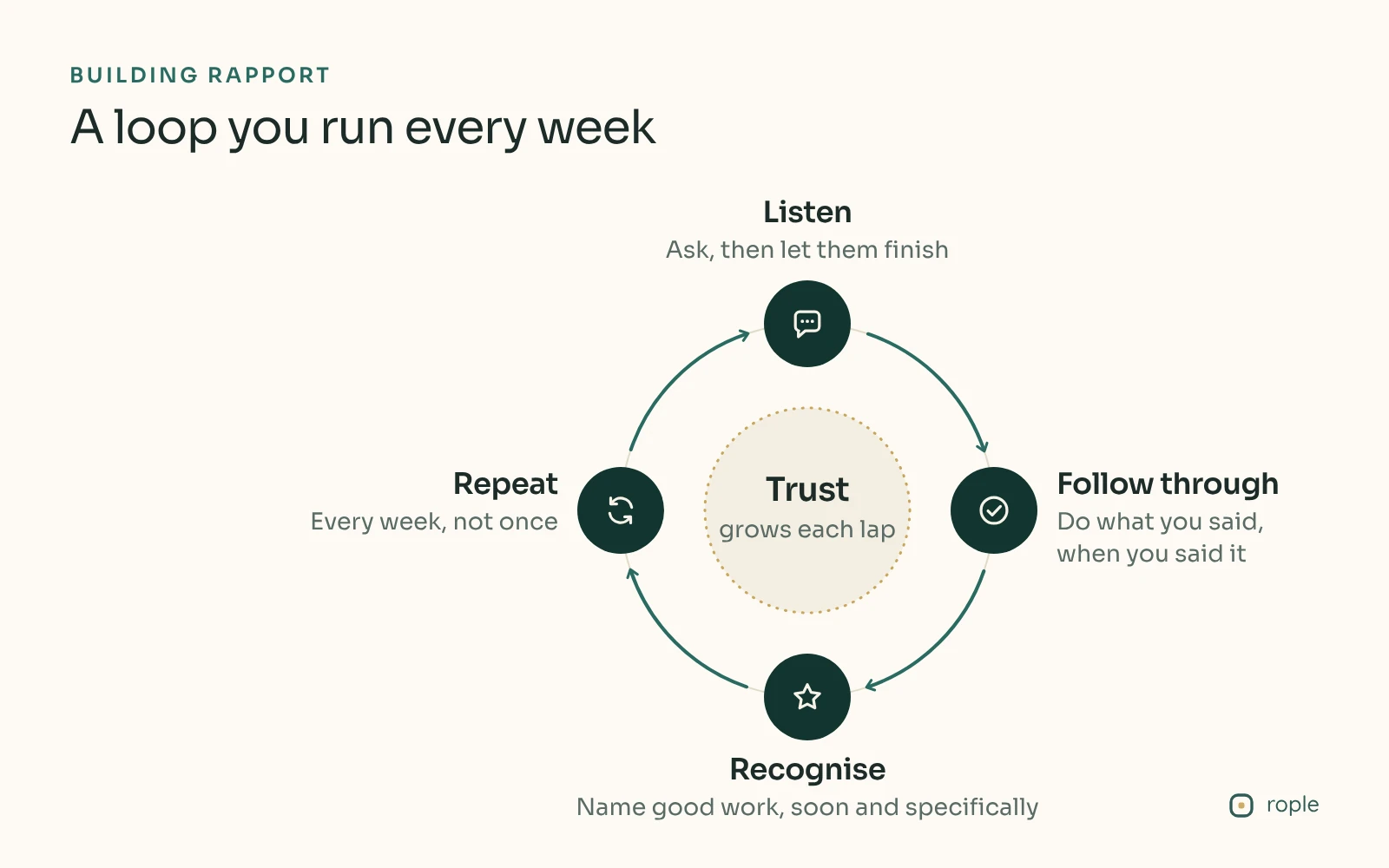
Rapport is a loop, not an event: listen, follow through, recognise, repeat.
How to build rapport with a new team quickly: 12 moves
1. Meet everyone one-to-one in the first two weeks
Not a group meeting, and not a quick chat at someone's desk. Book 30 to 45 minutes with each person, and treat it as the most important meeting of their week. If the team is large, start with the people whose work most affects others, but get through everyone within a fortnight.
2. Ask about their work before you talk about yours
Open with questions: what are you working on, what are you proudest of, what gets in your way. Then listen for longer than feels comfortable. A rule of thumb many managers use is to talk for no more than a third of a first one-to-one. Our first 90 days new manager checklist has five questions you can ask everyone.
3. Learn how each person likes to work
Some people want feedback in the moment; others want time to think. Some want detail; others want the headline. Ask directly: "How do you like to hear feedback?" and "What's the best way to get your attention when something is urgent?" Write the answers down and use them.
4. Share how you work, too
Tell the team how you like to work: when you're easiest to reach, how you make decisions, what you'll always want to know about. Some managers write this up as a one-page "how I work" note. It saves the team from guessing, and it shows you expect the relationship to go both ways.
5. Keep every small promise, and write them down
"I'll find out about that." "I'll send you the file." "I'll ask about your leave." These are the moments a new team uses to decide whether you mean what you say. Keep a list of every promise you make in your first month, and close every one, even if the answer is "I asked, and the answer is no."
6. Do one thing the team asked for, quickly
In your first few weeks, somebody will mention a small, fixable irritation: a recurring meeting nobody needs, a form that asks for the same thing twice, a shared folder nobody can find. Fix one of them, and say whose idea it was. It tells the team that what they say to you turns into action.
7. Give specific credit for real work, the same week
"Great job" is pleasant and forgettable. "The way you rewrote the client's brief on Tuesday meant the designers didn't have to start again, and we saved a week" is remembered. Name the situation, what the person did and the effect it had. The Center for Creative Leadership calls this structure Situation-Behaviour-Impact (CCL), and it works as well for praise as for criticism.
8. Ask for advice, and act on it visibly
Ask the person who has been there longest how they'd approach a problem. Ask the newest person what surprised them when they joined. Then, when you use what they told you, say so. Asking for advice is one of the quickest ways to show respect, as long as the advice goes somewhere.
9. Admit what you don't know
You don't need to have the answer to everything in month one, and pretending you do is easy to spot. "I don't know yet, I'll find out by Thursday" builds more trust than a confident guess that turns out wrong.
10. Protect their time
Cancel the meetings that don't need to happen. Don't send messages at night that look like they need an answer by morning. If you move a one-to-one, move it; don't cancel it. People notice when a manager treats their time as worth something.
11. React well to the first piece of bad news
At some point in your first month, someone will tell you something has gone wrong. What you do in the next ten seconds will be remembered for a long time. Thank them for telling you, ask what they need, and save the "how did this happen" for later. If people learn that bad news brings blame, they'll stop bringing it, and you'll find out about problems from clients instead.
12. Handle the first disagreement fairly
The first conflict on the team, or the first time someone disagrees with you openly, is a test everyone is watching. Listen to both sides, explain your decision and your reasons, and don't hold it against anyone afterwards. A fair decision people disagree with builds more trust than a vague one that avoids the question.
If you were promoted from inside the team
Building rapport with a team you used to be part of has its own difficulty: the rapport already exists, but it was built between peers. A few things help.
- Acknowledge the change openly in your first team meeting. Pretending nothing is different makes it awkward for everyone.
- Hold proper one-to-ones with former peers, even your closest friends on the team. Especially them.
- Stop taking part in the complaints about management. You're management now.
- Don't grab back the work you used to do. Your old role is someone else's chance to grow.
Building rapport with a remote or hybrid team
When you can't bump into people in the kitchen, rapport has to be built on purpose. Keep cameras optional but conversations regular. Start team calls with five minutes that aren't about work. Use one-to-ones for the person, not for status, which should be visible in the work itself. And write more down: a remote team learns who you are mostly from what you write.