The most affordable project management tools for a new manager are the ones with a free plan that fits your team today and a paid plan you won't outgrow in six months. For a small team, Trello (free for up to 10 collaborators), Jira (free for up to 10 users) and ClickUp (free for unlimited members, with low storage) cost nothing to start. Rople is free for up to 5 people. Once you pay, prices range from about ₦6,700 to ₦14,800 per person a month on yearly billing, or a flat monthly fee with Basecamp. The table below has the details, in naira. Prices checked October 2026.
Key takeaways
- Almost every tool here has a free plan. The real differences are how many people it covers and what it leaves out.
- The cheapest paid plans sit roughly between ₦6,700 and ₦14,800 per person a month on yearly billing. Monthly billing costs more.
- Watch for minimum seats and storage limits. They change the real price more than the headline number does.
- Pick by the kind of work: Jira for software, Notion for documents, Trello for simple boards, Rople when projects are tied to clients, invoices and goals.
- The hidden cost is the time spent copying updates between your project tool, your client list and your invoices.
Affordable project management tools compared
Prices checked October 2026, in naira, before tax. Rople's are its own naira prices. The other tools charge in US dollars, so their prices are converted at about ₦1,347 to the dollar (the CBN's official rate, 31 October 2026) and rounded to the nearest ₦10; your card or bank may convert at a different rate. Each price links to the vendor's own pricing page. Vendors change prices often, so check the page before you buy.
| Tool | Free plan | Cheapest paid plan | Good to know | Best for |
|---|---|---|---|---|
| Trello | Up to 10 collaborators and 10 boards per workspace | About ₦6,740 per user a month, yearly (Standard) | About ₦8,080 a month on monthly billing | Simple boards for small teams |
| Asana | Personal: 2 users, unlimited tasks and projects | About ₦14,800 per user a month, yearly (Starter) | Timeline and reporting start on Starter; Goals on Advanced | Teams running work across departments |
| ClickUp | Unlimited members, 60 MB storage, 5 Spaces | About ₦12,120 per user a month, yearly (Core) | Free storage runs out quickly with attachments | Teams who want many features in one tool |
| monday.com | Up to 2 seats and 3 boards | About ₦12,120 per seat a month, yearly (Basic) | Paid plans start at 3 seats | Visual, customisable boards |
| Notion | For individuals; limited blocks for 2 or more members | About ₦13,470 per member a month, yearly (Plus) | Strongest as docs and wiki, with tasks alongside | Teams whose work lives in documents |
| Jira | Up to 10 users, 2 GB storage | About ₦11,420 per user a month (Standard) | Built for software teams: sprints and backlogs | Software and product teams |
| Basecamp | One project, up to 3 people | About ₦39,060 a month flat, up to 5 users (Freelancer) | Flat prices, no per-user fees; 30-day trial | Small teams who work closely with clients |
| Rople | Up to 5 people, 3 active projects, goals and recognition | ₦9,000 per full seat a month, yearly (Starter) | ₦5,000 Team seats; at least 3 full seats; 14 days free, no card | Projects tied to clients, invoices and goals |
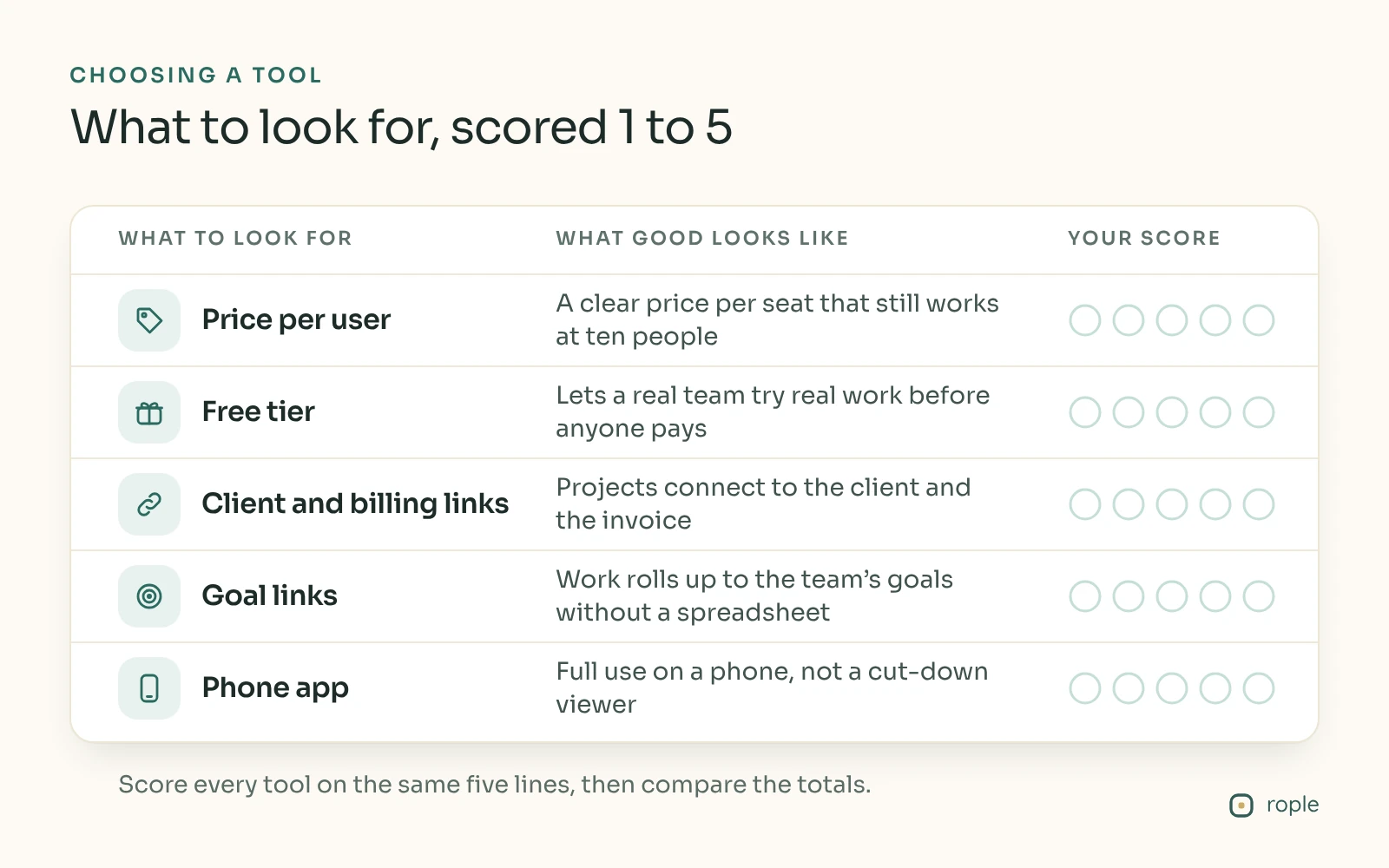
A five-line scorecard. Score every tool on the same lines, then compare the totals.
What "affordable" really means
The headline price is per person, per month, on yearly billing. What you actually pay depends on three more things.
Minimum seats. Some paid plans start at a set number of seats. monday.com's start at 3, and Rople's Starter is billed for at least 3 full seats. If you're a team of two, the minimum is the price.
What the free plan leaves out. A free plan that covers your headcount can still stop you on storage (ClickUp's free plan has 60 MB), boards (Trello and monday.com limit them) or features you'll want by month three, such as timelines, reporting or goals.
The tools around it. A project tool rarely works alone. If you also pay for a CRM to hold clients and an invoicing tool to bill them, the real cost is all three, plus the hours someone spends copying updates between them.
What a team of six pays
Here's the arithmetic for six people on each tool's cheapest paid plan, from the naira prices above, billed yearly. It's a rule-of-thumb comparison, not a quote: the dollar-priced tools move with the exchange rate.
| Tool | Monthly cost for 6 people | Note |
|---|---|---|
| Jira | ₦0 | Six people fit inside the free plan's 10 users |
| Trello Standard | About ₦40,440 | 6 × ₦6,740 |
| Rople Starter | ₦54,000 | 6 × ₦9,000 if everyone is on a full seat; less if some are on ₦5,000 Team seats |
| ClickUp Core | About ₦72,720 | 6 × ₦12,120 |
| monday.com Basic | About ₦72,720 | 6 × ₦12,120; check the seat options offered for your team size |
| Notion Plus | About ₦80,820 | 6 × ₦13,470 |
| Asana Starter | About ₦88,800 | 6 × ₦14,800 |
| Basecamp Pro | About ₦106,410 | Flat, covers up to 10 users |
The tools, one by one
Trello
Trello is the easiest of these to learn: boards, lists and cards, and you're working within minutes. The free plan is generous for a small team. It's less suited to work that needs dependencies, workload planning or reporting, which is where people start adding Power-Ups or moving on.
Asana
Asana is polished and good at work that crosses teams, with clear owners and due dates. Its free plan is now small (2 users), so most teams will pay from the start, and Goals sits on the Advanced plan rather than Starter.
ClickUp
ClickUp packs in more features per naira than almost anything else: tasks, docs, whiteboards, goals and time tracking. Unlimited free members is a real advantage. The trade-off is set-up time; there's a lot to configure, and a new manager can spend weeks building the system instead of running the team.
monday.com
monday.com is visual and very customisable, and many non-technical teams find it pleasant to use. The free plan suits two people trying it out. Paid plans start at three seats, and the features many teams want, such as timelines and automations, sit above Basic.
Notion
Notion is the best choice here when your team's work is mostly writing: briefs, plans, meeting notes, a wiki. Its databases can run simple projects well. It's less suited to tracking workload, deadlines across many projects, or anything to do with clients and money.
Jira
For software teams, Jira is hard to beat on price: free for up to 10 users, with sprints, backlogs and issue tracking. For a marketing agency or a construction firm, it's usually more structure than the work needs.
Basecamp
Basecamp charges a flat monthly fee rather than per person, which is predictable as you add people. It's calm and simple, and works well when clients need to see the work. It's lighter on reporting and doesn't try to handle goals or money.
Rople
Rople is different from the tools above in one way: its projects know who they're for and what they're worth. A client delivery project names the engagement it delivers. Milestones carry tasks, owners, dates and the evidence that proves the work is done, and the timeline keeps the date a milestone was first promised behind the date it moved to. On the Pro plan, a payment can wait on a milestone and becomes ready to invoice when the milestone is complete, and the project's Money tab shows budget, spend, revenue sold and margin. Tasks can sit under key results, so ticking one moves a goal.
Where it's weaker, honestly: there are no sprints or backlogs for software teams, it connects to fewer tools than the established names (Google Calendar, Calendly, website forms, a public API and webhooks, but no Slack app today), the Free plan allows 3 active projects and Starter allows 10, and Workflows is still in beta. If you only need a simple board, Trello will serve you well. Rople earns its place when the project, the client and the money are the same story. You can read more in what is Rople.