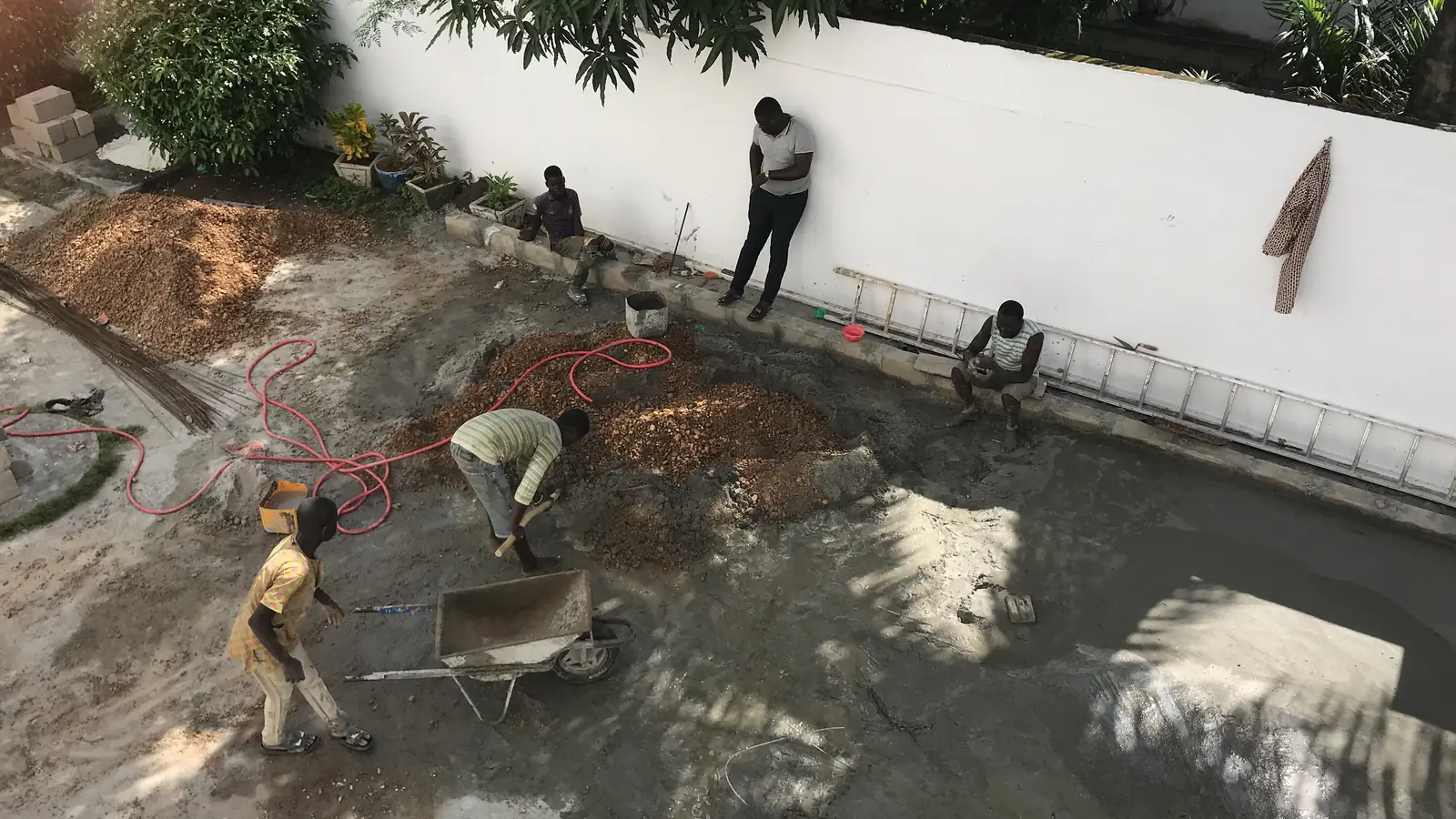
A construction site daily report template gives the site lead one page to fill in every working day: the date and weather, who was on site, what was done, where each stage now stands, what got in the way, what materials arrived or were used, and photographs. It gives the office the same picture of the site as the site lead has.
Key takeaways
- A good daily report takes ten minutes. It has seven sections, and none needs more than a few lines.
- Write it on site, before the site lead leaves. By evening, the details are gone.
- A report that ends in a WhatsApp group is a diary. A report that updates a schedule is a control.
- Report percentages per stage, not one figure for the whole build. Then weight the stages so the project figure is worked out, not guessed.
- Photographs and issues matter as much as the numbers. A delay with no note against it becomes an argument later.
What goes in a construction site daily report template?
Most construction guides agree on the same core contents. Fieldwire's daily report guide lists the date, project name and weather, the workforce on site including subcontractors, the work performed and progress notes, materials and equipment used or delivered, safety incidents or delays, and photographs (checked 17 November 2026). That matches what a Nigerian site lead needs, with two extras that matter in our conditions: access (a flooded road, a blocked gate) and security.
Here is a template you can copy, or download as a Word file.
Download the site daily report and weekly progress report (Word)
| Section | What to write | Example |
|---|---|---|
| 1. Header | Date, site, report number, author | 12 November 2026, Palm Court Phase 3, Ibeju-Lekki, report 48, Tunde Bello |
| 2. Weather and access | Conditions that affected work, road and gate | Heavy rain 1 pm to 4 pm; no concreting after 1 pm; access road passable |
| 3. Workforce | Headcount by gang or trade, and subcontractors | 14 labourers, 4 bricklayers, 2 steel fixers, 1 foreman; plumbing subcontractor absent |
| 4. Work done | What was completed or started, by location | Block B: blockwork to lintel level on the second floor, axis 1 to 4 |
| 5. Progress by stage | Where each open stage now stands, as a percentage | Foundation 100%, superstructure 38% (was 35%) |
| 6. Issues and delays | What stopped or slowed work, who must act | Rain stopped pour at 1 pm; sand delivery late by one day; engineer to confirm the lintel detail |
| 7. Materials | Delivered, used, running low | 400 blocks delivered against waybill 2231; cement down to 12 bags |
| 8. Photographs | Three or more, dated, labelled by location | Block B second floor; delivery; the lintel detail in question |
| 9. Sign-off | Who filed it, and who reviewed it | Filed by Tunde Bello; reviewed by Engr. Okafor |
The names and quantities are made up for the example. Use your own units: bags, trips, lengths, tonnes.
How do you write one on site in ten minutes?
A report that takes an hour will be skipped. These habits keep it short.
- Fill it in at the same time each day, before the site lead leaves. Do not rely on memory at home.
- Take photographs as you go, not at the end. A photo of the delivery lorry is better evidence than a line in the report.
- Write numbers, not adjectives. "14 labourers" beats "good turnout". "Late by one day" beats "delays".
- Name the next action and the person. "Engineer to confirm lintel detail by Monday" gives the office something to chase.
- Say when nothing happened. "No work, public holiday" is a report. A missing report is a question.
- Review each report. The project lead should mark each one reviewed within a day. A report nobody reads soon stops being filed.
If network is poor at your site, write the notes and take the photographs on the day, and enter them before you leave. Check how your own tool handles weak signal before you rely on it.
How should a daily report move the build schedule?
The point of a daily report is not the paperwork. It is to keep the schedule honest.
Break the build into stages, give each a weight that reflects its share of the work, and let each report update the percentage complete for each open stage. The project's progress is then the weighted sum, not a guess.
| Stage | Typical weight | Example % complete | Contribution |
|---|---|---|---|
| Land and title | 5 | 100% | 5.0 |
| Design and approvals | 8 | 100% | 8.0 |
| Setting out | 4 | 100% | 4.0 |
| Foundation | 15 | 60% | 9.0 |
| Superstructure | 25 | 0% | 0.0 |
| Roofing | 8 | 0% | 0.0 |
| Mechanical, electrical and plumbing | 12 | 0% | 0.0 |
| Finishing | 15 | 0% | 0.0 |
| External works | 5 | 0% | 0.0 |
| Handover | 3 | 0% | 0.0 |
| Whole project | 100 | 26.0% |
The weights are typical shares of a low-rise build, offered as a draft. Your quantity surveyor should change them to match your own bill of quantities.
Now suppose tomorrow's report says the foundation is at 70%. The project moves from 26.0% to 27.5%, because 10 points of a stage worth 15 is 1.5. Nobody typed 27.5%. The office read it from the report.
The second half is the comparison. If the foundation was planned to finish by the end of November, a straight line from its start date says where it should be today. A gap of more than ten points either way is worth flagging: behind, on track or ahead. That is a rule of thumb, not a standard. Pick a threshold and apply it to every site.
You can run this in a spreadsheet: one sheet for the weights, one for the daily percentages, one for the sum. It works for one site. It breaks down when four site leads each keep their own copy. This sheet has the weights and the sum set up.
Download the weighted progress sheet (Excel)
What goes in a weekly progress report?
The daily reports feed a weekly one for the managing director, the board or the buyers. Keep it to one page.
| Section | What it says |
|---|---|
| Week ending | The date |
| Overall progress | Percentage now, and last week's |
| Against plan | Ahead, on track or behind, and by how many points |
| Stages this week | The two or three that moved, with start and finish dates |
| Issues and decisions needed | Who must decide what, by when |
| Materials | Delivered, used, below reorder level |
| Manpower | Average headcount, and any gaps |
| Photographs | Three, labelled |
| Next week | What will be done, and what could stop it |
Buyers paying by instalment want to see progress. A short update with dated photographs does more for confidence than a promise. See tracking off-plan instalment payments for how the money side fits, and project milestones examples for ways to name the stages.